
Free cards + classroom lesson
Early Maths Picture Bingo
For Reception and Key Stage 1
Reinforce counting and introductory mathematical vocabulary.
- ✓ Four different printable cards
- ✓ Large picture caller sheet
- ✓ A4 landscape, four cards per page
- ✓ 15-minute lesson and eight caller prompts
- ✓ Separate two-page printable teacher guide
- ✓ No account or email required
Same eight pictures and words, 50 shuffled layouts. A4 PDF, one-time payment.
Download the free teacher guide (PDF) · Read the lesson
Free classroom use. The small BingoGen footer helps other teachers find the resource.
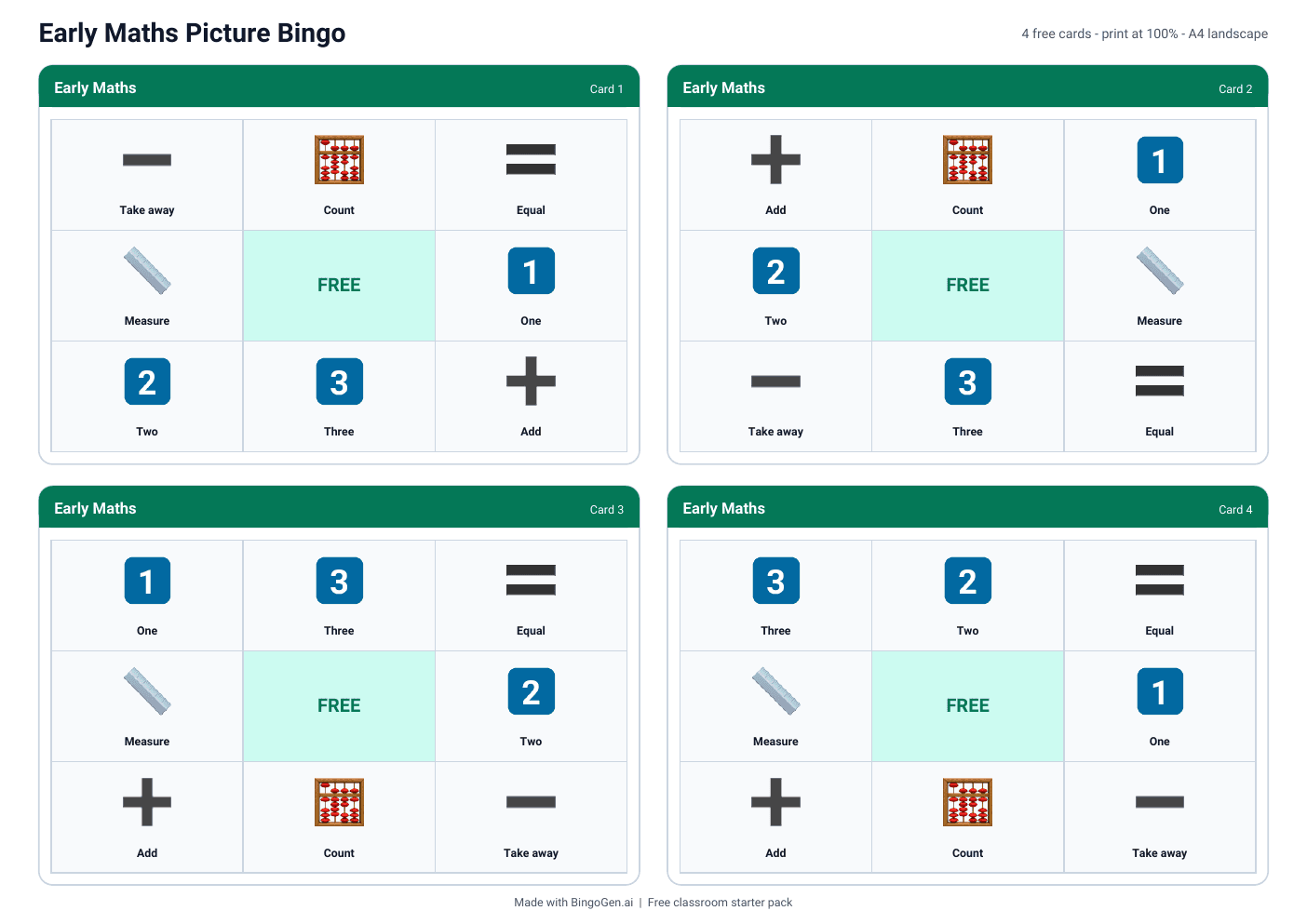
Actual free PDF page. The paid upgrade uses these same pictures and words.
What children practise
How to use the pack
- 1. Print page one at 100% on A4 paper.
- 2. Cut the four cards apart and give one to each player.
- 3. Use page two to call, show or describe each item.
- 4. Play for the first row, column or diagonal. Cards have different arrangements but share the same eight items, so full-house games finish together and line wins may tie.
Suggested 15-minute lesson · 1–4 players
Teach the words. Then play.
Connect small quantities and simple mathematical actions with their words and symbols.
Learning goals
- Match one, two and three to small sets of objects.
- Explain one mathematical action using objects: add, take away, count or measure.
Before the lesson
- Print the pack on A4 landscape and cut the four player cards apart. Keep the caller sheet and counters ready.
- Prepare three large classroom objects, a ruler and two equal small groups of objects for demonstrations.
Use large, age-appropriate counters. The card PDF is two A4 landscape pages; the teacher guide is a separate two-page A4 portrait PDF.
0-4 min
Build meanings with objects
Show sets of one, two and three. Demonstrate adding one object, taking one away and counting. Show two equal groups and use a ruler to model measuring length.
4-6 min
Introduce the card symbols
Match each demonstration to its caller tile. Give out cards, mark FREE and show a winning row of three.
6-12 min
Call and demonstrate
Shuffle the eight tiles. Say the exact label and, where useful, show the action. Keep called tiles aside and check claimed lines against them.
12-15 min
Explain one match
Ask a child to make a set of two or demonstrate adding one object. Show equal groups and invite an explanation of 'equal'. Revisit meanings that are unclear.
Caller prompts for all eight items
The labels below match the downloadable cards. Start with the direct label, then use the suggested prompt when it fits your group. Keep called tiles aside so you can check a winning line.
| Card label | What to say or demonstrate |
|---|---|
| One | Show one object. Find One. |
| Two | Show two objects. Find Two. |
| Three | Show three objects. Find Three. |
| Add | Put another object with a group. Find Add. |
| Take away | Remove an object from a group. Find Take away. |
| Equal | Show two groups with the same number. Find Equal. |
| Count | Touch each object once and say how many. Find Count. |
| Measure | Use a ruler to find a length. Find Measure. |
Vocabulary list to copy into your own activity
One item per line. You can select this list and copy it into the word caller or a custom card activity.
Make the activity fit your learners
Add support
Use real objects alongside the symbols and model one action at a time. Let pupils show their answer with objects rather than explain it verbally.
Offer a challenge
Change the quantities but keep the same action. Ask pupils to make two groups equal in number and explain what they changed.
A quick learning check
Can the child demonstrate an action as well as locate its symbol? A correct bingo match alone does not show understanding of calculation.
Playing with more than four children?
The free set has four layouts. You can play in pairs, rotate a small group, or print extra copies and explain that some players share a card. The optional 50-card pack gives more shuffled layouts of the same eight items. All cards share the vocabulary, so line wins may tie and full-house games finish together.
Before you call, show a winning pattern. For this shared eight-item set, a row, column or diagonal of three is a useful starting rule.