
Free cards + classroom lesson
Emotions Picture Bingo
For Early years and SEND
Name and discuss common feelings using friendly facial prompts.
- ✓ Four different printable cards
- ✓ Large picture caller sheet
- ✓ A4 landscape, four cards per page
- ✓ 12-minute lesson and eight caller prompts
- ✓ Separate two-page printable teacher guide
- ✓ No account or email required
Same eight pictures and words, 50 shuffled layouts. A4 PDF, one-time payment.
Download the free teacher guide (PDF) · Read the lesson
Free classroom use. The small BingoGen footer helps other teachers find the resource.
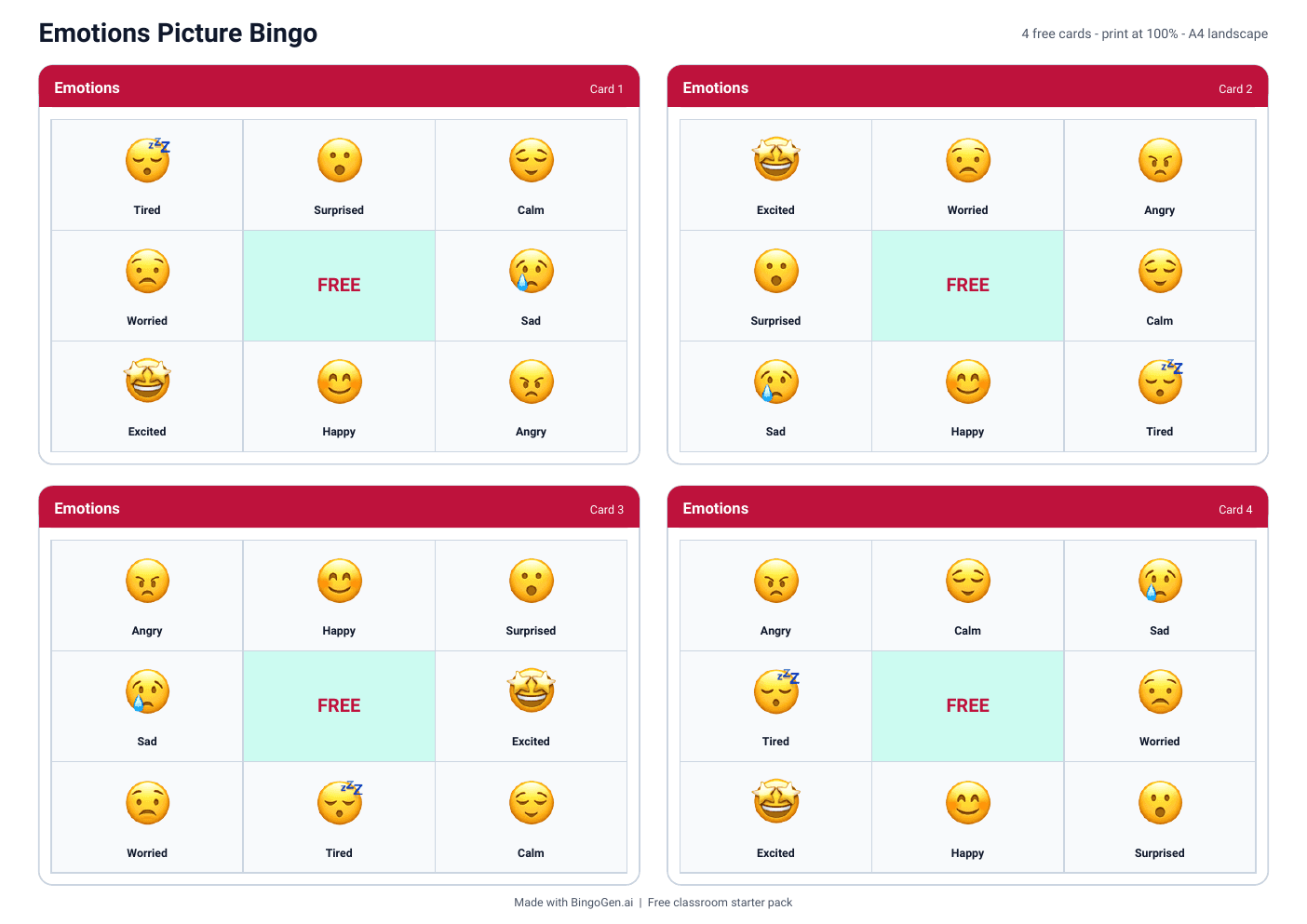
Actual free PDF page. The paid upgrade uses these same pictures and words.
What children practise
How to use the pack
- 1. Print page one at 100% on A4 paper.
- 2. Cut the four cards apart and give one to each player.
- 3. Use page two to call, show or describe each item.
- 4. Play for the first row, column or diagonal. Cards have different arrangements but share the same eight items, so full-house games finish together and line wins may tie.
Suggested 12-minute lesson · 1–4 players
Teach the words. Then play.
Develop language for describing possible feelings in pictures and fictional situations.
Learning goals
- Recognise the eight agreed feeling labels on the caller sheet.
- Suggest a feeling a fictional character might experience and give a simple reason.
Before the lesson
- Print the pack on A4 landscape, cut apart the four cards and provide counters.
- Pre-teach the eight labels. Plan a fictional example for each, without asking children to share personal experiences.
Use large, age-appropriate counters. The card PDF is two A4 landscape pages; the teacher guide is a separate two-page A4 portrait PDF.
0-3 min
Name possible feelings
Show the eight caller pictures and name their intended labels. Say that people can show feelings differently and pictures are only prompts.
3-5 min
Demonstrate a turn
Use a made-up character who is tired after a busy day. Show Tired and model marking it. Hand out cards, mark FREE and demonstrate a line of three.
5-9 min
Play with direct labels
Call each agreed feeling label and show its picture. Record calls and verify lines. Keep discussion optional and use fictional examples rather than asking children to reveal how they feel.
9-12 min
Discuss a character
Offer a short fictional situation. Ask which feelings the character might have and why. Accept more than one plausible answer; this discussion is separate from the game's fixed labels.
Caller prompts for all eight items
The labels below match the downloadable cards. Start with the direct label, then use the suggested prompt when it fits your group. Keep called tiles aside so you can check a winning line.
| Card label | What to say or demonstrate |
|---|---|
| Happy | Our picture label is Happy. A character enjoys a game. |
| Sad | Our picture label is Sad. A character misses a friend. |
| Angry | Our picture label is Angry. A character's tower is knocked over. |
| Surprised | Our picture label is Surprised. A character hears unexpected news. |
| Tired | Our picture label is Tired. A character needs a rest. |
| Excited | Our picture label is Excited. A character looks forward to a trip. |
| Worried | Our picture label is Worried. A character wonders what will happen. |
| Calm | Our picture label is Calm. A character feels settled. |
Vocabulary list to copy into your own activity
One item per line. You can select this list and copy it into the word caller or a custom card activity.
Make the activity fit your learners
Add support
Use the same label and image together each time. Allow pointing or a familiar communication aid, with no requirement to act out a feeling.
Offer a challenge
Ask whether a fictional character could feel two things at once. Invite different explanations without turning them into right-or-wrong bingo clues.
A quick learning check
Can the child use a feeling word about a fictional character? Do not interpret a picture choice as evidence about the child's own emotional state.
Playing with more than four children?
The free set has four layouts. You can play in pairs, rotate a small group, or print extra copies and explain that some players share a card. The optional 50-card pack gives more shuffled layouts of the same eight items. All cards share the vocabulary, so line wins may tie and full-house games finish together.
Before you call, show a winning pattern. For this shared eight-item set, a row, column or diagonal of three is a useful starting rule.